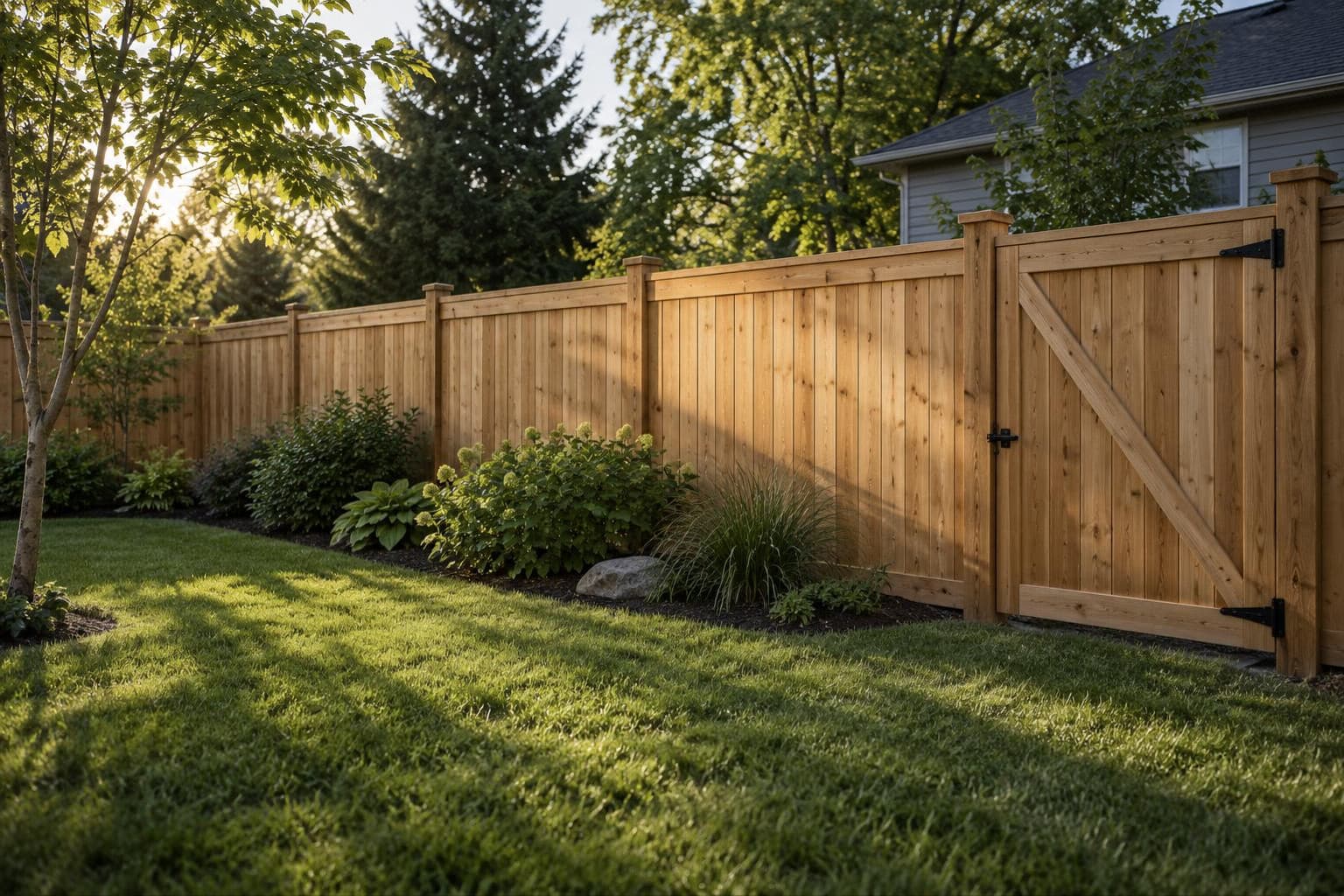
How a board on board fence is counted
A board on board fence has two layers of boards on the same side of the rails. The first layer goes on with a space between the boards. The second layer covers each space and overlaps the boards underneath on both edges. From the front it looks solid, and there is no straight gap through it.
The count follows the build, layer by layer. A second layer board has to span the space and overlap both neighbors, which sets the first layer spacing:
First layer spacing = board width − 2 × overlap
The first layer fills the section at one board plus one space per step, and the second layer puts one board over every space:
First layer = (section + spacing) ÷ (board width + spacing), rounded up; second layer = first layer − 1
On average each board covers its width minus the overlap, which is a quick check for boards per foot.
The rest of the fence is counted like any wood fence. Posts go at every corner, end and gate, sections are no longer than your post spacing, and rails follow the height: two per section up to 4 ft, three up to 6 ft and four above that. Boards, rails and nails get 10% extra for waste, the allowance Inch Calculator recommends.
The overlap and spacing, in numbers
America's Fence Store builds its board on board fences with "3 1/2" spacing between the pickets" on the first layer. With 1x6 boards, which ProWood lists at an actual 5 1/2 in wide, that leaves 1 in of overlap on each edge: 5.5 − 2 × 1 = 3.5. That 1 in overlap is the calculator's default.
- Effective width: 5 1/2 in − 1 in = 4 1/2 in per board, so about 2.67 boards per foot.
- First layer on an 8 ft section: (96 + 3.5) ÷ (5.5 + 3.5) = 11.06, so 12 boards.
- Second layer: one over each of the 11 spaces, 11 boards. Together 23 boards.
A bigger overlap closes the fence more but costs more boards. For an 8 ft section of 1x6:
| Overlap each edge | First layer spacing | Boards per 8 ft |
|---|---|---|
| 1/2 in | 4 1/2 in | 21 |
| 3/4 in | 4 in | 21 |
| 1 in | 3 1/2 in | 23 |
| 1 1/2 in | 2 1/2 in | 25 |
With 1x4 boards, 3 1/2 in wide, the same 1 in overlap gives a 1 1/2 in spacing and 39 boards per 8 ft section. Narrow boards need many more pieces and nails for the same length.
A worked example
The calculator opens on 150 ft of 6 ft board on board fence with two corners and one 4 ft walk gate. That is three 50 ft sides, one of them split into two 23 ft stretches by the gate: 146 ft of fence.
- Posts at 8 ft at most give 3 sections of about 7.67 ft in each 23 ft stretch and 7 sections of about 7.14 ft on each 50 ft side. That makes 20 sections on 22 posts.
- A 7.67 ft section is 92 in: (92 + 3.5) ÷ 9 = 10.6, so 11 front boards and 10 behind, 21 boards. A 7.14 ft section, about 85.7 in, takes 10 and 9, 19 boards.
- 6 × 21 + 14 × 19 = 392 boards, plus 10% gives 432 boards.
- Three rails per section is 60, or 66 rails with waste.
- 91 bags of 50 lb fast-setting concrete for 42 in holes.
The same fence as a single layer privacy fence takes 359 boards. The second layer adds about a fifth more boards and nails.
Does the board size matter?
Fence boards are not always dimensional lumber. A 1x6 is 3/4 by 5 1/2 in, while the cedar dog ear pickets Stine Home + Yard sells are 5/8 by 5 1/2 in. The width is what drives the count, so both give the same numbers here. If your boards are a different width, measure one and adjust the overlap until the first layer spacing matches what you plan to cut as a spacer.
How do you build the two layers?
The order America's Fence Store describes is simple: set the posts, fix three rails per bay on a 6 ft fence, then nail the first layer with a 3 1/2 in spacer between the boards. The second layer goes over the spaces, centered so the overlap is the same on both edges. Each board takes two 6d nails at each rail, and each rail end two 16d nails. Keep the top and bottom rails about 7 to 8 in from the top of the fence and from the ground.
What people ask next
- Board on board or shadow box? A shadow box fence alternates the boards on both sides of the rails, so both yards see the same face, and air passes at an angle between the two sides. The shadow box fence calculator counts pickets per side.
- What does it cost? Board on board is priced like a wood privacy fence with more boards. The wood fence cost calculator gives installed and materials ranges.
- Single layer instead? The privacy fence calculator counts boards edge to edge and lets you switch between styles.
- For posts, concrete and other fence types, start from the fence calculator.