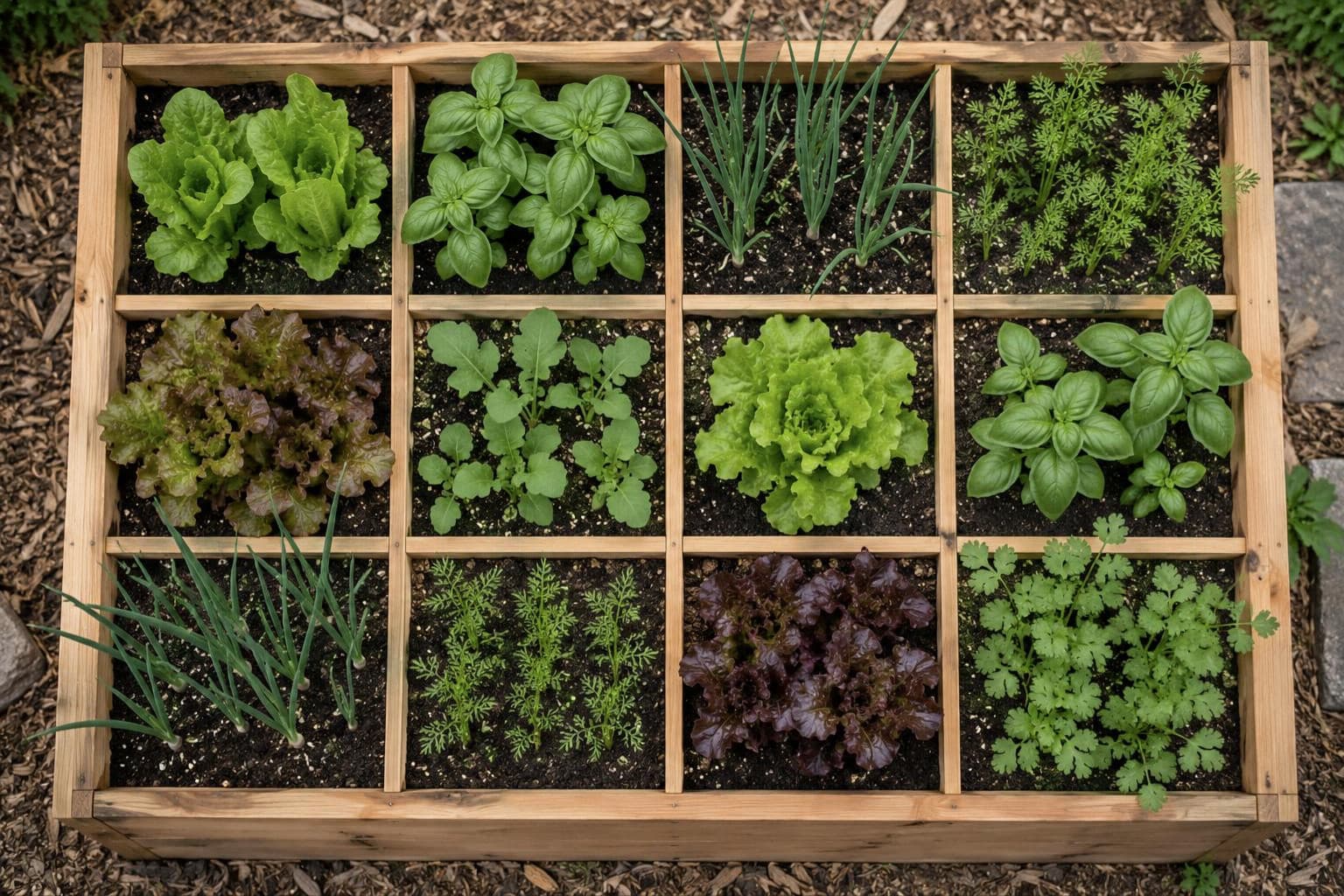
How to plan a raised bed
Start with the bed, not the seed catalog. Decide the size and height, mark which side faces north, then fill the bed one square foot at a time. The planner above opens with a 4 by 8 ft bed, 12 inches deep, already planted with tomatoes, peppers, basil, bush beans, leaf lettuce, carrots, onions and marigolds, so you can see a finished plan before you change a thing. Press Clear bed to start from an empty grid, or Start over to go back to one empty bed. As you place crops, the totals below the beds show plants, what to buy, soil and water.
How many plants fit in a 4x8 raised bed
A 4 by 8 ft bed has 32 squares of 1 sq ft. How many plants that holds depends entirely on the crops. The table shows a bed filled with a single crop, using the square foot counts in our crop data, which come from extension square foot gardening guides such as the one from the UC Master Gardeners of Tulare-Kings Counties.
| Crop | Plants per square | Whole 4x8 bed |
|---|---|---|
| Tomato, pepper, eggplant, broccoli, cabbage | 1 | 32 |
| Cucumber (on a trellis) | 1 | 32 |
| Sweet corn | 2 | 64 |
| Leaf lettuce, Swiss chard, basil, marigold | 4 | 128 |
| Pole beans | 8 | 256 |
| Bush beans, peas, beets, onions, garlic, spinach | 9 | 288 |
| Carrots, radishes | 16 | 512 |
| Squash, zucchini, pumpkin, watermelon, cantaloupe | 1 per 2 squares | 16 |
The example plan comes to 208 plants: 3 tomatoes, 3 peppers, 16 marigolds, 8 basil, 54 bush beans, 24 lettuce, 64 carrots and 36 onions.
Square foot gardening counts explained
Square foot gardening divides the bed into a grid of 1 ft squares and plants each square with 1, 4, 9 or 16 plants. The UC Master Gardeners' guide ties the count to the spacing on the seed packet: 12 inch spacing is 1 plant per square, 6 inches is 4, 4 inches is 9 and 3 inches is 16.
plants = squares planted × plants per square
Large vining crops get less than one plant per square. The same guide lists watermelon, zucchini, pumpkin, melons and squash at 1 plant per 2 square feet, so the planner draws them as a block of two squares holding one plant. Tap one square and the block claims its neighbor too, turning or shifting to fit at an edge. If a bed is too small for the whole block, it is drawn with a dashed border and the plan check warns that the plant is short of room.
Some crops, such as dill, leeks, zinnias and asparagus, have no square foot count in our sources. You can still place them. The planner fits their equidistant spacing into 12 inch squares, using the wider end of the range, so dill at 9 inches gets 1 per square, leeks at 4 to 6 inches get 4. Crops spaced wider than 12 inches get a block of squares; asparagus at 18 inches takes a 2 by 2 block. These counts are marked "est." in the crop list.
Layout tips that hold up
- Keep beds about 4 ft wide. UF/IFAS Gardening Solutions says a 4 ft wide box lets you reach the middle from the sides. The planner warns when a bed is wider.
- Leave paths you can work from. UF/IFAS calls aisles 3 ft wide a good width, and the UC Master Gardeners space boxes 3 ft apart. Tend the bed from the path and never walk on the growing soil.
- Put trellises on the north side. UF/IFAS advises placing the trellis for cucumbers or other climbing crops on the north edge so it does not shade the rest of the bed. Set which side of the drawing faces north and the planner flags cucumbers, pole beans and peas that sit elsewhere.
- Replant as you harvest. The UC guide suggests adding compost to a finished square and planting a different crop. Duplicate a bed to sketch the fall version.
Companion planting, honestly
Linda Chalker-Scott of Washington State University reviewed companion planting and found "no scientific basis" for the traditional companion plant lists, comparing them to horoscopes. The same review says diverse plantings can help in documented ways: mixed crops attract and keep beneficial insects and make it harder for pests to find their host plants.
So the planner shows a companion note only where our crop data has an extension source for it. It notes carrots with radishes (Utah State University), dill with cucumbers or broccoli (NC State Extension), and corn with beans and squash (the Three Sisters example from WSU). It warns when dill touches carrots, since NC State Extension says dill planted too close can reduce a carrot crop. It stays silent on the rest.
Soil and water for the plan
Soil is the bed area times its height. The example bed is 4 × 8 ft × 1 ft = 32 cu ft, or 1.19 cu yd: 22 bags of 1.5 cu ft or 16 bags of 2 cu ft, rounded up. In Mel's Mix, which the Square Foot Gardening Foundation gives as one third each peat moss (or coir), vermiculite and blended compost, each ingredient is about 10.7 cu ft. For topsoil and compost blends, settling and a lumber cut list, use the raised bed soil calculator.
For water, N.C. Cooperative Extension says a summer vegetable garden needs about 1 inch a week, and the University of Arizona gives 0.623 gallons for 1 inch over 1 sq ft. The example bed needs 32 × 0.623 = about 20 gallons a week, less whatever rain has fallen.
How to use the planner
- Tap to plant. Pick a crop, then tap squares, or tap a square first and then a crop. Press Done or Escape to stop.
- Drag to fill. With a mouse, drag across squares to plant a row in one move. On a phone, switch on "Drag to plant on touch screens" first, so a normal swipe still scrolls a long bed.
- Keyboard. Tab to a bed, move with the arrow keys, press Enter to plant the selected crop and Delete or Backspace to clear a square. Ctrl+Z (Cmd+Z on a Mac) undoes and Shift+Ctrl+Z redoes.
- Beds. Add 4x8, 4x4, 3x6, 2x8 or custom beds up to 8 by 24 ft. Clearing and removing a bed can be undone.
- Save and share. The plan saves in your browser. Copy share link puts the whole plan in the link.
To work out spacing for one crop in rows, use the plant spacing calculator, and for quick counts per square the square foot gardening calculator.
Printing a plan
Print gives one page per large bed, each with its grid, a legend of crops with their counts, and a final page listing plants, what to buy or sow, soil and water. Download PDF opens the same print view: choose Save as PDF as the printer.