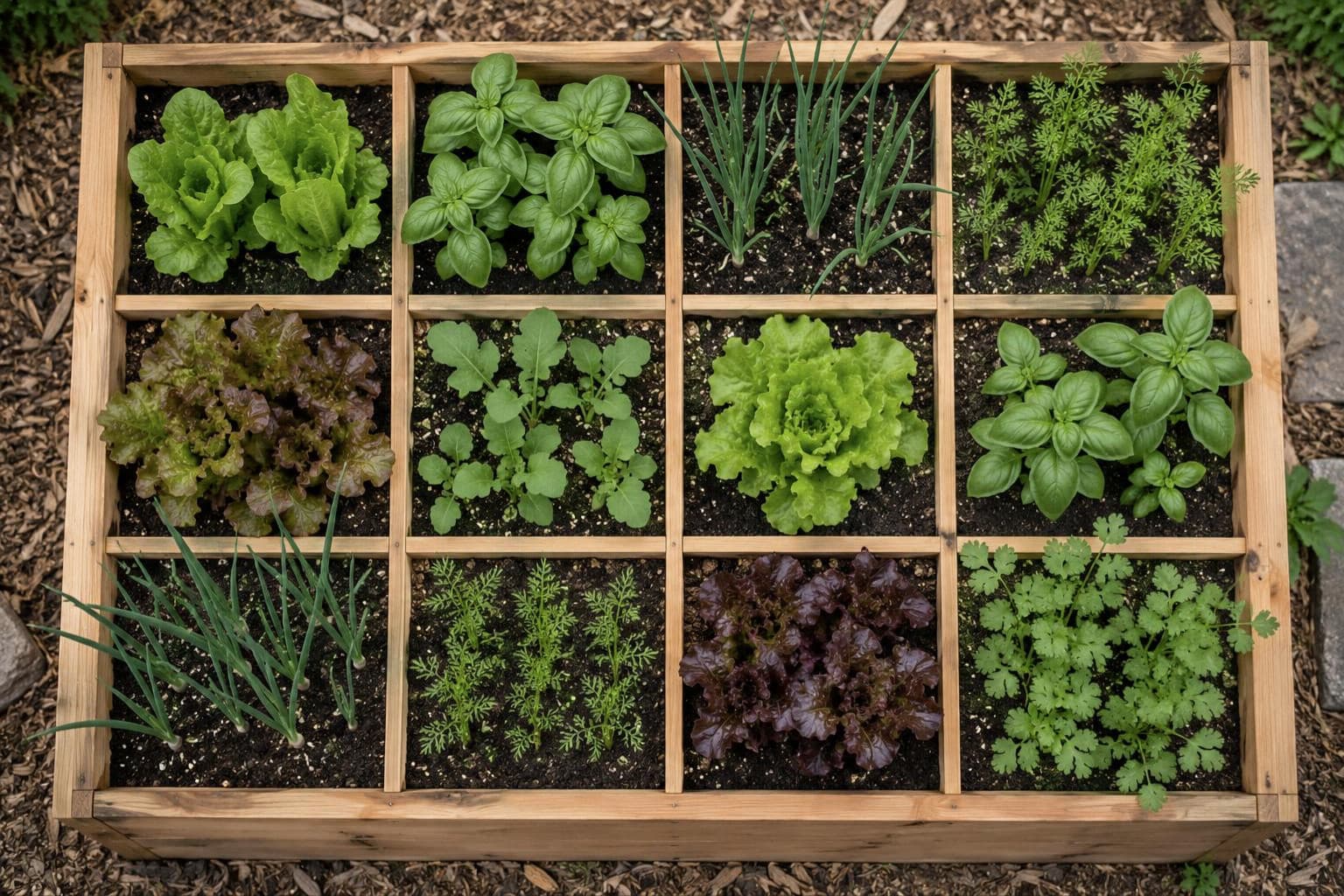
How square foot gardening counts plants
A square foot garden is a raised bed divided into a grid of 1 ft squares. Instead of spacing plants in rows, you plant each square with a set number of one crop: large plants take a whole square, small ones share it. UF/IFAS Gardening Solutions describes the usual bed as 4 by 4 ft, because you can reach the middle from any side without stepping on the soil, which gives sixteen squares.
The counts follow a simple pattern. A square holds 1, 4, 9 or 16 plants, set out as a 1 by 1, 2 by 2, 3 by 3 or 4 by 4 grid inside the square. Crops that spread wider than a square, such as squash and watermelon, get one plant per two squares.
plants = squares × plants per square
The spacing inside the square follows from the count: 12 in divided by the square root of the plants per square. Nine per square puts plants 4 in apart; sixteen puts them 3 in apart; four puts them 6 in apart. The chart shows that spacing for every crop, so you can mark it out with your fingers.
Worked example: a 4 x 4 bed
Plant the sixteen squares like this:
| Squares | Crop | Per square | Plants |
|---|---|---|---|
| 4 | Carrot | 16 | 64 |
| 4 | Bush bean | 9 | 36 |
| 4 | Lettuce | 4 | 16 |
| 2 | Tomato | 1 | 2 |
| 2 | Pepper | 1 | 2 |
That is 120 plants in 16 squares. The planner above adds it up the same way as you tap squares, and shows each square's plants as dots so you can see the layout before you sow. Swap the two pepper squares for squash and you get one squash plant, because squash needs two squares per plant.
The same bed needs 8 cu ft of soil at 6 in deep, which matches the Square Foot Gardening Foundation's figure for a 4 by 4 bed. The foundation's Mel's mix is one third peat, one third vermiculite and one third blended compost, with coir as a substitute for peat. For bags and a mix split, use the raised bed soil calculator.
Where the numbers per square come from
The chart uses the square foot counts in our crop data, gathered from extension square foot guides by UC Cooperative Extension Master Gardeners and UF/IFAS Extension Leon County. Where a variety differs, it gets its own row: head lettuce takes a whole square while leaf lettuce fits four, and pole beans are listed at 8 per square against 9 for bush beans.
Guides do not all agree. UF/IFAS Gardening Solutions puts spinach at 4 and onions at 16 per square, while the guides behind our chart list both at 9. Treat the counts as a starting point: a compact variety can go denser, and a large one, or a crop you let grow to full size, needs fewer.
UF/IFAS also suggests growing climbing crops such as cucumbers on a trellis along the north edge of the bed, so they do not shade the rest, and planting two per square there.
Using the planner
- Pick a crop, then tap or click squares to plant them. Tapping a planted square with the same crop clears it.
- With a keyboard, the arrow keys move between squares, Enter or Space plants, and Delete clears.
- Undo steps back through every change, including Clear bed.
- Print plan prints the bed with its totals; Print chart prints the full chart on its own.
Choose 4 x 4, 4 x 8 or 3 x 6 ft, or set any bed up to 16 squares long and 8 wide.
Next questions
How many plants per square foot for crops not in the chart? Use the in-row spacing instead. The plant spacing calculator turns any spacing into plants per square foot and counts them for your bed.
What about a bigger plan with several beds? This page plans one bed by the square. For a hedge along a border see the hedge spacing calculator.