How the plant count is worked out
The calculator places plants the way you would on the ground. In a bed the first plant sits half a spacing in from the edge, and each next plant goes one full spacing further along until the row runs out of room. Then it starts the next row. Keeping half a spacing to the edge means plants in two beds side by side still end up a full spacing apart. Under More options you can switch the margin off and plant right on the edge.
- Square: rows are one spacing apart and plants line up in both directions.
- Triangular (staggered): every second row shifts by half a spacing and rows sit closer together, at spacing × 0.866. Each plant is the same distance from six neighbours.
- Rows: you set the in-row spacing and the distance between rows separately, as seed packets and planting charts list them.
For a round bed the calculator lays the same grid over the circle, keeps every plant that stays half a spacing inside the rim, and tries the grid both centred on a plant and centred between plants. For a row or hedge it counts plants along the length, with one line or several.
The formula for plants per area
When you only know the area, the count is the area divided by the ground each plant takes.
plants = area ÷ (in-row spacing × row spacing)
In a square pattern the row spacing equals the in-row spacing. In a triangular pattern it is the in-row spacing × 0.866, which is why triangular spacing fits 1.155 times as many plants. An acre is 43,560 sq ft and a hectare is 10,000 m², so plants per acre is 43,560 divided by the square feet per plant.
The University of Georgia's horticulture conversion tables (Bulletin 931) give the same figures: at 12 inch spacing, 100 sq ft holds 100 plants in a square pattern and 115 in a triangular one; at 6 inches the figures are 400 and 462. A square 4 by 4 ft spacing gives 2,722 plants per acre.
Worked examples
A raised bed. An 8 by 4 ft bed at 9 inch spacing holds 60 plants in triangular rows and 50 in square rows. The per-area figure at 9 inches is about 2.05 plants per sq ft triangular, which would suggest 65 in 32 sq ft; the half spacing at the edges takes the rest.
A narrow bed can reverse the gain. The same bed at 8 inches holds 72 plants square but 69 triangular, because every shifted row loses a plant at the end. The calculator counts both patterns for your exact bed and tells you when the other one fits more.
Rows in a field. Plants 12 inches apart in rows 36 inches apart take 3 sq ft each: 43,560 ÷ 3 = 14,520 plants per acre. At 12 inches triangular it is 50,298 per acre, against 43,560 square.
A round bed and a row. A 6 ft round bed at 12 inches fits 23 plants triangular and 21 square. A 20 ft row at 12 inches takes 20 plants, with half a foot clear at each end.
Spacing for common vegetables
These are in-row spacings from extension planting guides. Use the low end for compact varieties and rich soil, and the high end for large varieties or where air flow matters. Pick a crop in the calculator to see its figures in your units, and a variety where the spacing differs.
| Crop | Spacing |
|---|---|
| Tomato | 18 to 36 in |
| Summer squash | 18 to 36 in |
| Pepper | 12 to 24 in |
| Broccoli, kale | 12 to 24 in |
| Cabbage | 12 to 18 in |
| Cucumber | 12 to 18 in |
| Potato | 10 to 18 in |
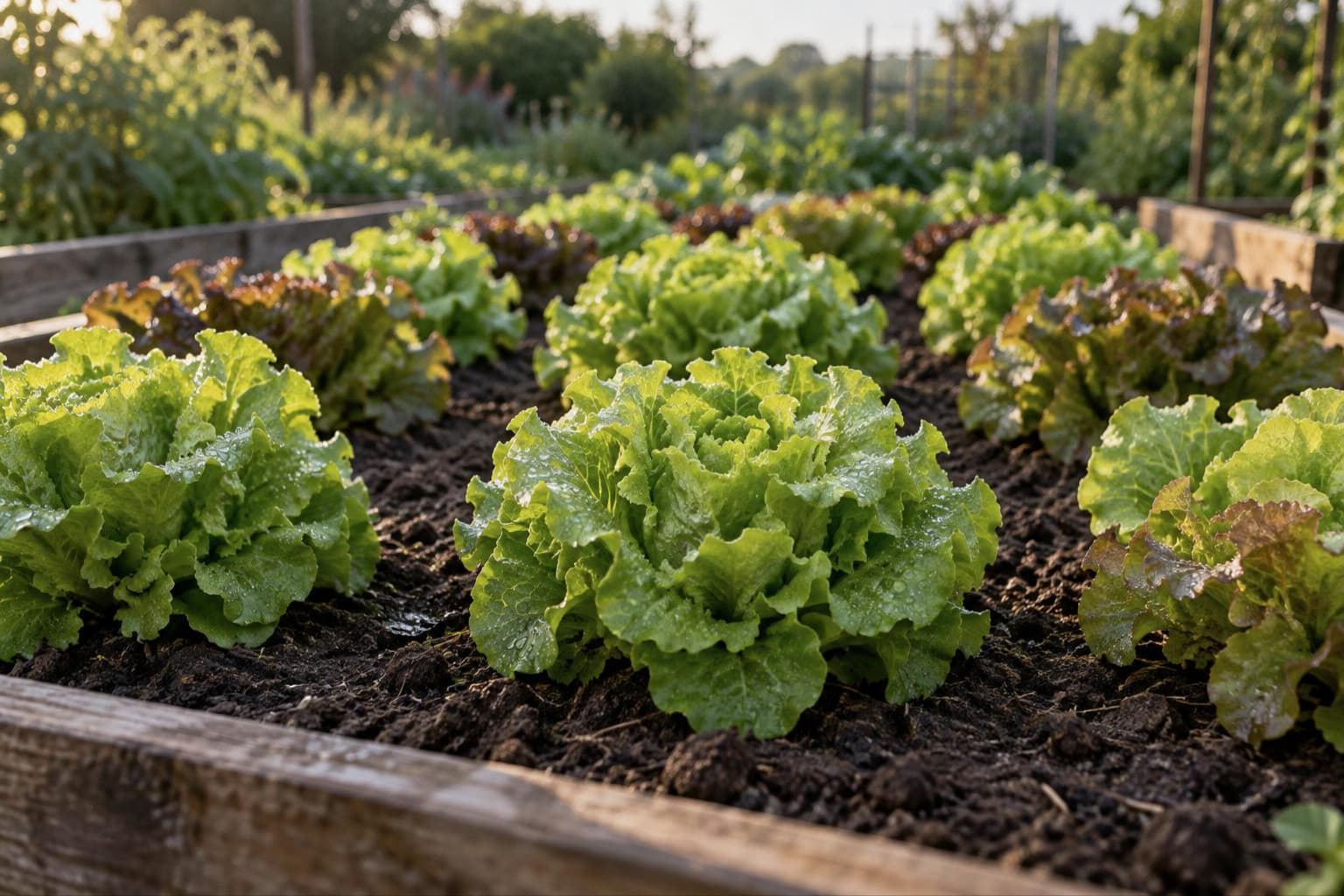
| Head lettuce | 6 to 10 in |
| Garlic | 3 to 6 in |
| Spinach, leaf lettuce | thin to 4 in |
| Onion | 2 to 4 in |
| Bush bean | 1 to 3 in |
| Carrot | thin to 1.5 to 2 in |
Most figures come from Virginia Cooperative Extension's home garden planting guide. Garlic is from University of Maryland Extension and leaf lettuce from University of Illinois Extension.
Row spacing, beds and walkways
Planting guides list a spacing between rows that is often wider than the in-row spacing, because it leaves room to walk and hoe. In a raised bed you never step between plants, so you can usually plant at the in-row spacing in every direction; choose Square or Triangular for that. Choose Rows for in-ground rows with paths.
Pots and 5 gallon buckets
Switch to pot mode to count plants per container. Where the crop data has a published figure for a 5 gallon container it is shown first; Texas A&M AgriLife lists one tomato, one eggplant and one squash plant per 5 gallon pot. Otherwise the count comes from the pot's width and the spacing, with at least one plant per pot and a warning when the pot is smaller than the crop's minimum.
Next steps
Planting by the square foot? The square foot gardening calculator plans a bed square by square. For a hedge of a given length use the hedge spacing calculator, for an orchard the tree spacing calculator, and to fill the bed the raised bed soil calculator.