How trees per acre are worked out
Each tree needs a patch of ground as big as its spacing in the row times the distance to the next row. Divide the area by that patch and round down:
trees per acre = 43,560 ÷ (in-row spacing in ft × row spacing in ft)
In metric, use 10,000 m² per hectare and spacing in metres. The three layouts differ only in the row spacing:
- Square: rows as far apart as the trees in the row.
- Rectangular: rows wider apart than the trees in the row, the way orchard spacing tables list in-row and between-row distances.
- Triangular (staggered): every second row shifts by half a spacing and rows sit 0.866 of a spacing apart, so each tree is the same distance from six neighbours. At the same spacing that fits 1.155 times as many trees as a square layout.
The per-area figure ignores the edges of the field. Choose Plot to lay the trees out in a rectangle of known length and width, with half a spacing kept clear at the boundary, or Row or windbreak to count trees along a line.
The University of Georgia's conversion tables (Bulletin 931) give the square figures directly: 4 by 4 ft is 2,722 plants per acre, 5 by 5 ft is 1,742 and 6 by 6 ft is 1,210. The calculator returns the same numbers.
Worked examples
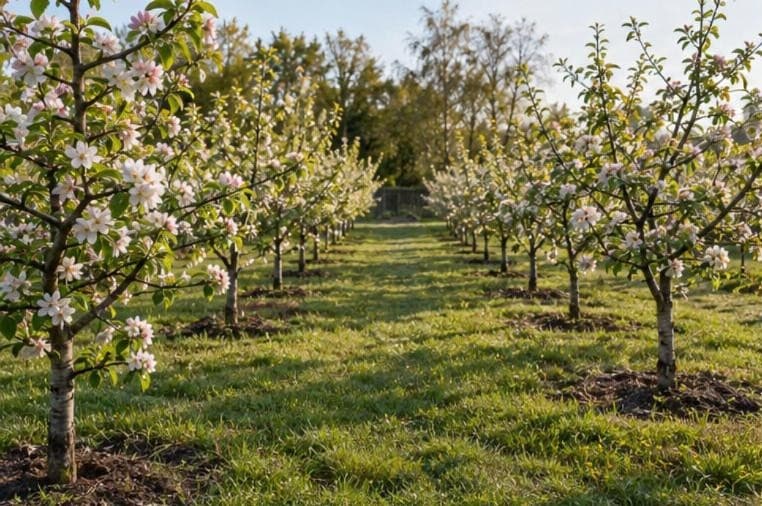
Semi-dwarf apples. Penn State Extension spaces semi-dwarf apple trees from 12 by 20 ft on M.7 rootstock to 18 by 26 ft on MM.111. The preset starts at the midpoints, 15 ft in the row and 23 ft between rows: 43,560 ÷ 345 sq ft gives 126 trees per acre. Five acres take 631 trees. In metric the preset shows 4.6 by 7 m, which gives 310 trees per hectare.
Dwarf apples. At the midpoint of the dwarf range, 7.5 ft in the row and 14 ft between rows, an acre holds 414 trees.
Square or triangular. Trees 20 ft apart need 400 sq ft each on a square grid, which gives 108 per acre. Staggered at the same 20 ft they give 125 per acre, and per hectare 269 against 310.
A windbreak row. A 200 ft line of trees 15 ft apart, starting half a spacing from each end, takes 13 trees. Add rows with Number of rows, and choose Triangular (staggered) to offset them.
Spacing by rootstock and fruit
For apples the rootstock, not the variety, sets tree size and spacing. The presets come from Penn State Extension's Table 4.3 and Virginia Cooperative Extension's Tree Fruit in the Home Garden:
| Tree | In the row | Between rows |
|---|---|---|
| Apple, standard (seedling rootstock) | 25 to 30 ft | not given |
| Apple, semi-dwarf (M.7, MM.111) | 12 to 18 ft | 20 to 26 ft |
| Apple, dwarf (M.26, B.10, G.935) | 7 to 8 ft | 12 to 16 ft |
| Apple, fully dwarfing on a trellis (M.9, B.9, G.41) | 3 to 5 ft | 12 ft |
| Peach | 18 to 20 ft | not given |
| Plum | 20 ft | not given |
| Pear, standard | 20 to 25 ft | not given |
| Pear, dwarf | 12 ft | not given |
| Sweet cherry | 25 ft | not given |
| Sour cherry | 18 ft | not given |
Where no row spacing is published, the calculator uses the in-row spacing for both directions until you change it. University of Maine Cooperative Extension suggests the 25 ft end for standard apples in cold, short-season regions and more room where winters are warm. Fully dwarfing trees need a trellis or a post.
Screening trees such as arborvitae and Leyland cypress are in the list too. For a hedge-like line of them, the hedge spacing calculator adds a double staggered row and a check against mature width.
Next questions
How many trees per acre for a Christmas tree plot? NC State Extension notes that growers plant Leyland cypress for Christmas trees 4 to 8 ft apart, far closer than a landscape screen, because the trees are cut young. Choose Leyland cypress, then the Christmas tree variety.
What about shrubs and smaller plants per acre? The plant spacing calculator does the same math in inches and centimetres for vegetables, groundcovers and perennials.