How the seed starting dates are counted
Every date on the schedule is counted from one of two frost dates: the last spring frost and the first fall frost. The calculator takes the weeks for each crop from the extension guides behind our crop data, mostly Colorado State University's Vegetable Planting Guide (GardenNotes #720), and counts back or forward from your frost date.
Start indoors = last frost date − weeks indoors
The same idea gives the other dates:
- Transplant = last frost date + the crop's offset. Hardy crops such as broccoli and onion go out before the last frost; tender crops such as tomato and pepper go out 2 weeks after it.
- Harden off covers the 2 to 3 weeks before the earliest transplant date. Clemson Extension gives 2 to 3 weeks, and NC State says to start at least 2 weeks ahead.
- Sow outdoors = last frost date + the crop's offset, for crops sown straight into the bed.
- Fall sowing = first fall frost date − weeks before frost.
A range such as "6 to 8 weeks" becomes a window. The early end gives you bigger transplants and the late end smaller ones, and either works. Where a crop record has a transplant date but no indoor start (eggplant, for now), the calculator uses Clemson's table of 6 to 8 weeks indoors before setting out.
Worked example: Minneapolis, ZIP 55401
ZIP 55401 is in zone 5a. Its nearest NOAA station is Lower St Anthony Falls, 1.2 miles away. NOAA's 1991 to 2020 normals for that station put the average last spring frost on Apr 23 and the average first fall frost on Oct 16.
Tomatoes need 6 to 8 weeks indoors:
- 8 weeks before Apr 23 is Feb 26 and 6 weeks before is Mar 12, so sow between Feb 26 and Mar 12.
- Transplanting is 2 weeks after the last frost: May 7.
- Hardening off runs from Apr 16 to May 6.
Peppers get the same dates, and onions, at 6 to 8 weeks indoors, share the Feb 26 to Mar 12 window but go out 2 to 4 weeks before the frost, Mar 26 to Apr 9. Cucumbers and squash are sown outdoors on the frost date itself.
Average, safer or safest
A frost date is a probability, not a promise. NOAA publishes each date at several odds, and the calculator offers three:
| Setting | Spring means | 55401 last frost | 55401 first frost | Tomato sowing | Tomato transplant |
|---|---|---|---|---|---|
| Average | half of years get a later frost | Apr 23 | Oct 16 | Feb 26 to Mar 12 | May 7 |
| Safer | 3 years in 10 get a later frost | Apr 30 | Oct 10 | Mar 5 to Mar 19 | May 14 |
| Safest | 1 year in 10 gets a later frost | May 7 | Oct 2 | Mar 12 to Mar 26 | May 21 |
The Safer column is the date The Old Farmer's Almanac prints, and for this station it matches the Almanac's Apr 30 and Oct 10 exactly. Choosing a safer setting moves spring dates later and fall dates earlier, because the safe side flips with the season.
A good rule is to start seeds from the average date, since indoor sowing carries no frost risk. For tomatoes, peppers and basil, check the transplant date against the safer or safest setting. A seedling can wait a week in its pot, but it cannot undo a frost.
Denver shows how much a ZIP code can matter. ZIP 80202 sits in zone 6a, yet its station (Denver Water Dept, 5,228 ft) has an average last frost of Apr 30, a week later than Minneapolis. The zone alone would suggest the opposite.
The fall schedule
Switch to the Fall tab to count back from the first frost. For 55401 at average dates:
- Kale and collards, at 13 weeks before frost, are sown by Jul 17.
- Brussels sprouts, at 17 weeks, are sown by Jun 19.
- Peas, at 8 to 9 weeks, are sown from Aug 14 to Aug 21.
- Beets have a last sowing date, 8 weeks before frost: Aug 21.
Choosing Safest pulls all of these earlier. Only crops whose sources give a fall timing appear here.
Grow lights
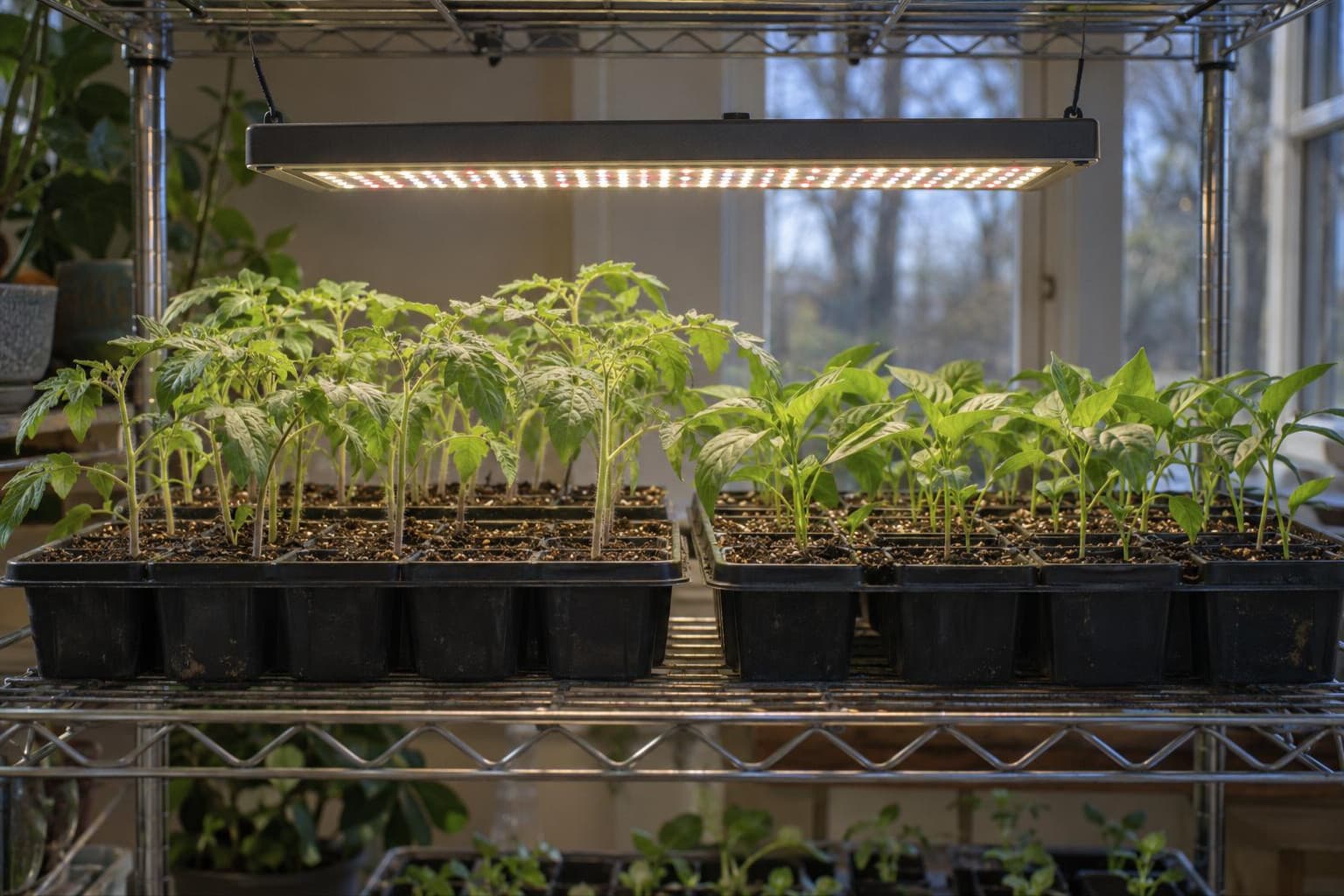
Clemson Extension calls for 16 to 18 hours of bright light a day, with fluorescent tubes 2 to 4 in above the seedlings. The University of Maryland Extension gives 14 to 16 hours, with fluorescent or LED fixtures 2 to 6 in above the plants on an outlet timer. Raise the lights as the plants grow.
Seed starting mix recipe
Start seeds in a sterile, soilless mix, not garden soil. NC State's Extension Gardener Handbook explains that garden soil is not sterile, is too heavy and does not drain well. The same handbook gives a simple homemade recipe:
Seed starting mix = 1 part fine pine bark + 1 part sphagnum peat moss + 1 part perlite (by volume)
UMD lists the other common ingredients: coir, vermiculite, compost and rice hulls. Keep the mix at 65 to 75°F until the seeds come up. After that, UMD suggests 55 to 60°F nights and 65 to 70°F days. Sow two or three seeds per cell and keep the strongest seedling.
Potting up and hardening off
Pot seedlings up into larger containers shortly after the first true leaves appear, while they are small enough to recover quickly (UMD). Clemson says to do it at one or two sets of true leaves. The schedule notes it without a date, since it depends on how fast your seedlings grow.
Hardening off starts once plants are about 3 in tall:
- Set the plants outside by day and bring them in before sundown.
- Give them a little more direct sun each day for 2 to 3 weeks (Clemson).
- Skip days below 45°F or with strong wind (NC State).
Where the dates can mislead
The frost dates are 30-year normals from the nearest station, not a forecast, and a hollow or a hillside can run a week off. The calculator names the station, its distance and its elevation so you can judge how well it matches your garden. If you keep your own records, choose My dates and enter them.
Next steps
- For a printable table for your whole zone, open when to start seeds indoors in zone 6 or zone 7.
- To know how many transplants you need, the plant spacing calculator shows how many fit your bed.