How the fence calculator works
Every fence, whatever it is made of, starts with the same skeleton: a line broken into straight runs, posts at the ends and corners, and line posts in between. The calculator builds that skeleton first, then hangs the right materials on it.
- The line. Enter the total length and the number of corners, type each side, or draw the fence on the map. Gates are cut out of the line, so a 4 ft gate in a 150 ft fence leaves 146 ft to build.
- The posts. Each straight stretch is split into equal sections no longer than your post spacing, so you never end with a 2 ft leftover section. Corner, end and gate posts are counted separately because they carry more load.
- The materials. Rails, pickets, panels, chain link fabric or wire are counted per section. Anything you cut gets 10% extra for waste.
- The footings. Each post hole is sized from the post: three times its width across, and deep enough to hold half of the post's height above ground, plus 6 in of gravel. Concrete is the hole volume minus the post and the gravel, divided by the yield printed on the bag.
Posts per straight run = sections + 1, where sections = run length ÷ spacing, rounded up
A worked example
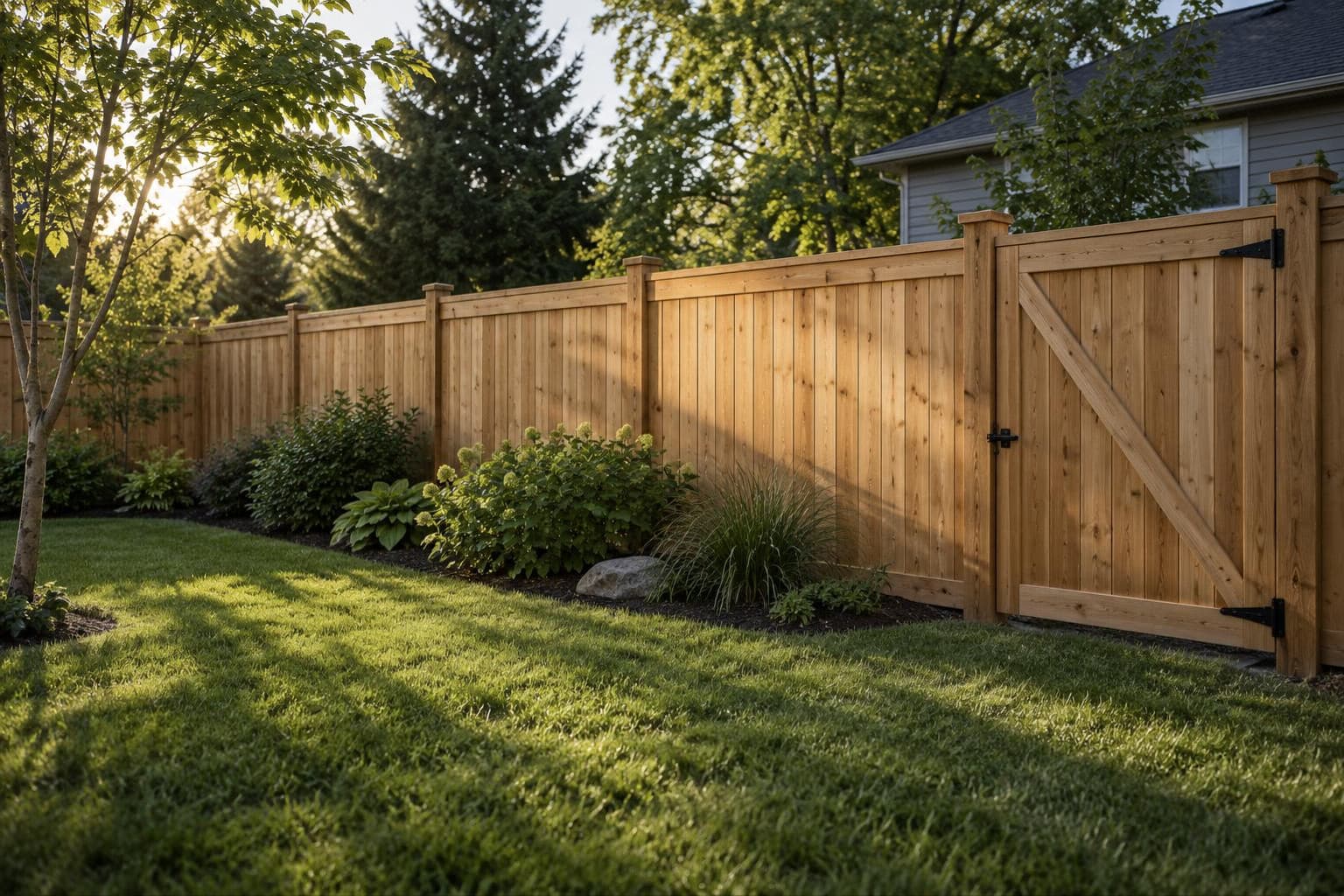
A 150 ft wood privacy fence, 6 ft tall, with two corners and one 4 ft walk gate, posts at most 8 ft apart:
- 146 ft of fence in 20 sections, with 22 posts: 16 line posts, 2 corners, 2 ends and 2 gate posts
- 3 rails per section, 66 rails after waste
- 359 dog ear boards (1x6, 5.5 in wide)
- Holes 10.5 in across and 42 in deep, which takes 91 bags of 50 lb fast-setting concrete, about 4 per post
- 10 ft posts, because 6 ft stands above ground and 3 ft sits in concrete on 6 in of gravel
Installed, national cost guides put that fence at roughly $2,700 to $7,900 including the gate. The same line as 4 ft chain link needs 18 posts and 4 rolls of fabric and costs about $1,300 to $3,400.
Drawing your fence on a map
Switch to Draw on map, find your address and tap each corner of the fence line on the satellite photo. The calculator measures every side along the ground, shows the lengths on the map, and adds up the area if you close the shape. Drag a corner to fine tune it. Aerial photos can be off by a few feet at the property line, so check the corners with a tape before you order, and have the line surveyed if the fence sits on a boundary.
How deep should fence posts be?
Quikrete's rule is a third of the post's overall length in the ground, which is half of the height above ground, with 6 in of gravel under the post. A 6 ft fence therefore needs holes about 42 in deep and a 10 ft post. Where the ground freezes, the hole also has to reach at least 6 in below your local frost depth, which your building department sets. Corner and gate posts deserve more: Penn State Extension sets line posts at 36 in and corner or gate posts at up to 48 in. The fence post depth calculator works this out for your fence and soil.
How far apart should fence posts be?
| Fence | Usual spacing |
|---|---|
| Wood privacy or picket | 8 ft or less |
| Horizontal boards | 6 ft or less |
| Vinyl | Panel width, usually 6 or 8 ft |
| Aluminum | About 6 ft |
| Chain link | 10 ft maximum |
| Split rail | About 10.5 ft with 11 ft rails |
| Barbed wire | 12 to 14 ft |
| Woven wire | 14 to 16 ft |
The wood and chain link figures come from the Merchants Metals and Master Halco installation guides, vinyl and aluminum from the Bufftech and Jerith instructions, and farm fences from University of Kentucky Extension. The fence post spacing calculator finds an even spacing for any run.
What does a fence cost?
HomeAdvisor puts the most common installed price at about $23 per foot, within a range of $6 to $50. Wood runs about $10 to $35 per foot, vinyl $15 to $40 and chain link $8 to $40, depending on height and region. Gates, removing an old fence and a permit come on top. The fence cost calculator compares every material for your length.
Fences this calculator covers
- Wood: privacy, picket, board on board, shadow box and horizontal
- Panels: vinyl, aluminum, wrought iron and composite
- Chain link with every fitting, from tension bands to loop caps
- Split rail with 2 or 3 rails
- Farm: barbed, woven, high tensile and electric wire, with bracing, for which the farm fence calculator adds livestock presets