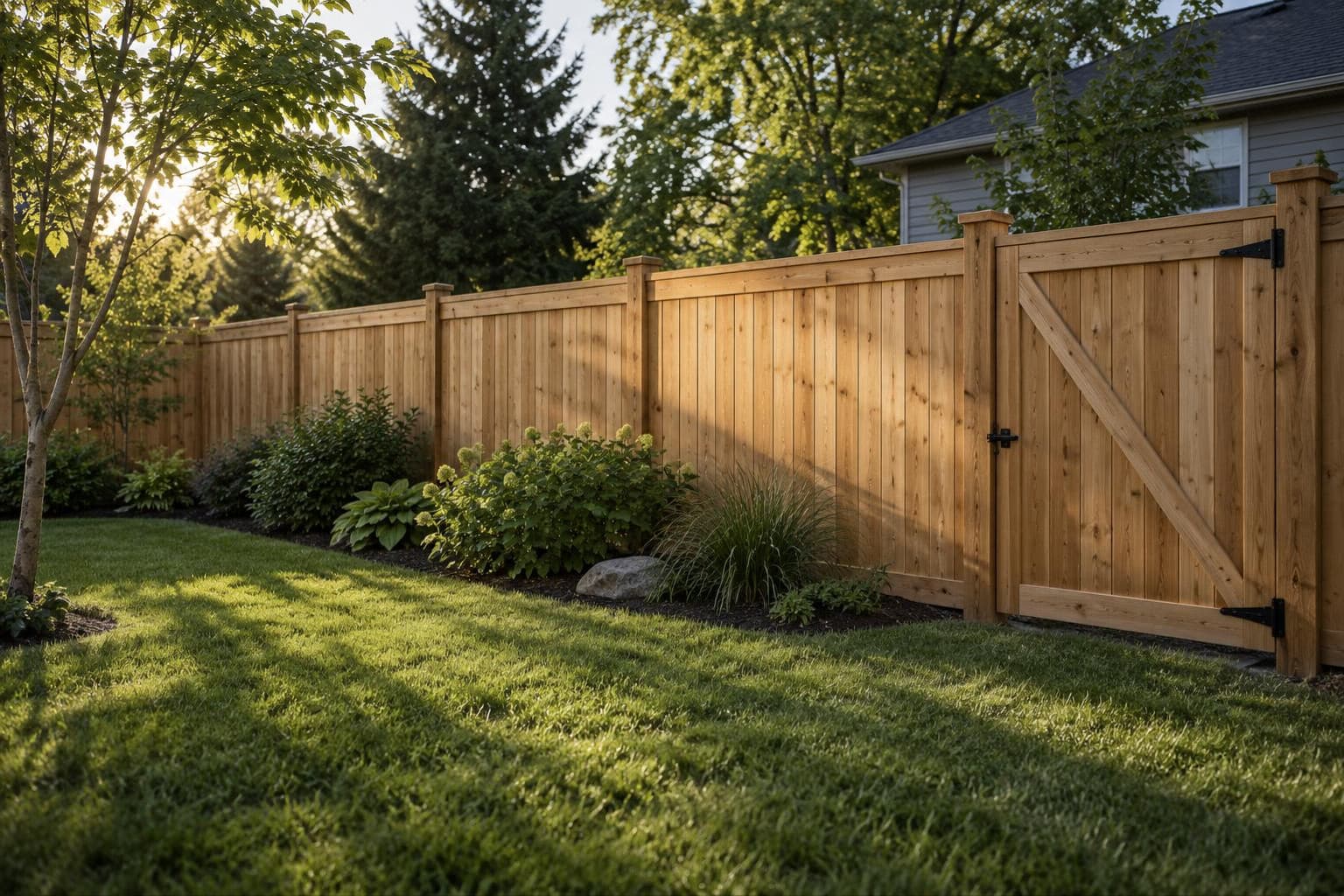
How to space fence posts evenly
Measure the straight run from end post to end post, divide by the widest spacing your fence allows, and round up. That gives the number of sections. Then divide the run by that number to get the spacing that makes every section the same.
Sections = run length ÷ maximum spacing, rounded up · Spacing = run length ÷ sections · Posts = sections + 1
If you already know how many posts you want, the second mode runs it backwards: spacing = run length ÷ (posts − 1). Both numbers are measured center to center, which is how rails, panels and chain link line posts are specified.
A worked example
A 100 ft run of wood privacy fence with an 8 ft maximum:
- 100 ÷ 8 = 12.5, rounded up to 13 sections.
- 100 ÷ 13 = 7.69 ft, which is 7 ft 8 1/4 in on center.
- 13 + 1 = 14 posts, both ends included.
If you step off 8 ft from one end instead, you get twelve full sections and a 4 ft stub at the far end, on the same 14 posts. Spreading them out costs nothing and every rail is cut to the same length. With 4x4 posts (3.5 in actual), the clear gap between post faces is 7 ft 4 3/4 in.
Two more from the calculator: 75 ft at an 8 ft maximum gives 10 sections of 7 ft 6 in and 11 posts. A 50 ft run at a 6 ft maximum gives 9 sections of 5 ft 6 5/8 in and 10 posts.
Typical maximum spacing by fence type
| Fence type | Post spacing, on center | Source |
|---|---|---|
| Wood privacy or picket | 8 ft standard; America's Fence Store sets posts 7 ft 10 in apart | Family Handyman; America's Fence Store |
| Horizontal wood | 3 to 6 ft | FenceRail.com |
| Vinyl | 72 in or 96 in, to suit 6 or 8 ft panels | Weatherables |
| Aluminum, 6 ft sections | about 72 in: 71 3/4 to 72 3/4 in depending on brand and post size | Fortress, Freedom, Jerith instructions |
| Chain link | 10 ft maximum for line posts | Chain Link Fence Manufacturers Institute |
| Split rail, 11 ft rails | 10 ft 4 in to 10 ft 6 in | Split Rail Fence Store |
| Farm board fence | 8 ft | University of Kentucky, University of Tennessee |
| Barbed wire | 12 to 14 ft | University of Kentucky |
| Woven wire | 14 to 16 ft | University of Kentucky |
| High tensile | 16 to 60 ft | University of Kentucky |
| Electric | 20 to 75 ft | University of Kentucky |
The fence type menu in the calculator fills in the spacing the rest of this site uses for that fence: 8 ft for wood, 6 ft for vinyl and aluminum panels (or 8 ft vinyl), 10 ft for chain link, 10 ft 6 in for split rail, and 12, 14, 25 and 40 ft for barbed, woven, high tensile and electric wire.
Chain link post spacing
The Chain Link Fence Manufacturers Institute says line posts should be "no greater than 10 feet on center", and a CLFMI brochure counts them by dividing the total footage by 10 and rounding up. That is the calculator's first mode with a 10 ft maximum. A 130 ft run divides exactly into 13 sections of 10 ft on 14 posts; a 125 ft run needs 13 sections as well, at 9 ft 7 3/8 in. Terminal posts go at each end, corner and gate, and each stretch between them is spaced on its own.
When even spacing is not the answer
Panel fences come at a fixed width. Fortress gives a maximum of 71 3/4 in on center for its 2 in aluminum posts, and Weatherables sets vinyl at 72 or 96 in, so the posts follow the panel and the odd length ends up in one panel cut to fit. Use the calculator there to see how short that last piece will be, and consider moving the end post or a gate so it disappears.
For wood, chain link and wire, the rails, fabric and wire are cut or stretched anyway, so equal spacing is free and looks tidier.
Does the spacing include corners and gates?
Treat every straight piece between corners, ends and gate posts as its own run. A corner post is shared by the two runs that meet at it, and a gate opening is not fenced, so measure each stretch of fence on its own. The fence post calculator does that split for a whole fence line and counts line, corner, end and gate posts separately.
Next steps
Once the posts are marked, the fence post depth calculator gives the hole for each one, and the chain link fence calculator and fence calculator turn the layout into a full material list.