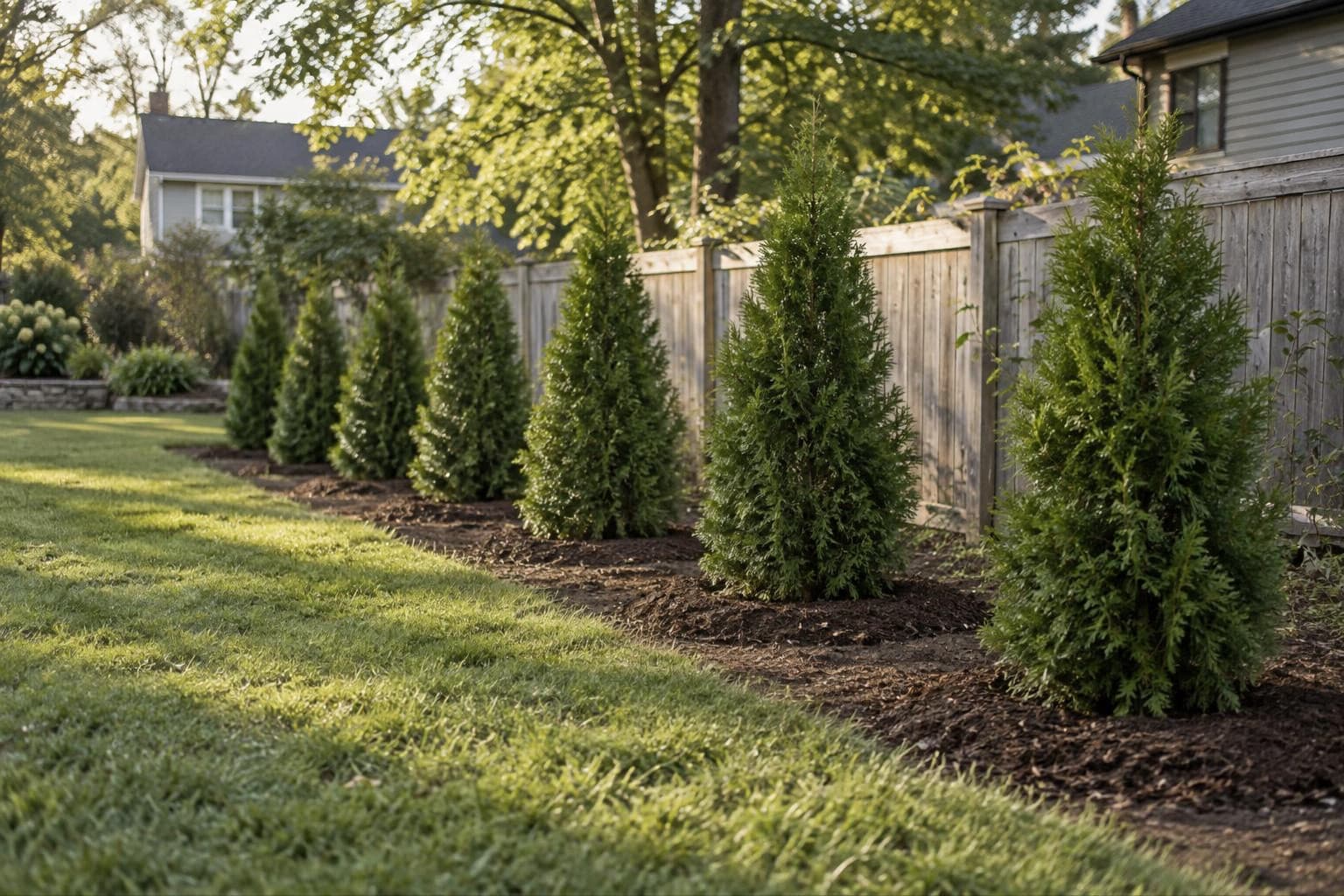
How many hedge plants you need
The count is the hedge length divided by the spacing between plants. With the default setting the first plant goes half a spacing in from one end and the last one half a spacing before the other end, so the hedge fills the length without spilling past it:
plants per row = hedge length ÷ spacing, rounded down
If you want a plant right at each end, for example to finish at two corners, switch the ends under More options; that adds one plant per row.
A double staggered row is two parallel rows with the second row shifted by half a spacing, so each plant sits opposite a gap. The RHS suggests it for hedges thicker than 90 cm (3 ft). The second row takes the same number of plants as the first or one fewer, depending on where the half spacing lands at the end.
Worked examples
Emerald Green arborvitae, 30 ft. Oregon State and Washington State University Extension put Emerald Green 3 to 4 ft apart; the calculator starts at the midpoint, 42 in. A 30 ft single row takes 8 plants, or 9 with a plant at each end. A double staggered row with the rows 18 in apart takes 16.
A 10 m hedge in metric. At 45 cm apart, a single row takes 22 plants, about 2.2 per metre. As a double staggered row with the rows 45 cm apart it takes 43. The Royal Horticultural Society's layout for hedges thicker than 90 cm, rows 45 cm apart with plants 90 cm apart in each row, takes 21 plants for the same 10 m.
Spacing guidance behind the presets
Hedge spacing depends on how you will keep the hedge more than on the plant.
- Formal, sheared hedges are planted close so they knit together. Iowa State University Extension spaces sheared hedge shrubs 1 to 2.5 ft apart; that range is the preset for privet, yew and hornbeam as sheared hedges. For a low boxwood edging about 12 in tall, LSU AgCenter plants as close as 8 in.
- Informal hedges and screens are spaced by mature size. Iowa State gives 2 to 4 ft for shrubs that grow 6 to 8 ft tall and 4 to 6 ft for shrubs of 8 to 12 ft.
- Single rows in the UK are usually 30 to 60 cm apart in the row, according to the RHS, depending on the plant's final size, the size of hedge you want and its vigour.
The cultivar can matter more than the species. Emerald Green arborvitae stays 3 to 4 ft wide, while Green Giant spreads 12 to 18 ft and is set 6 to 8 ft apart for a dense screen. Leyland cypress grows fast and wide: Clemson Extension advises at least 12 to 15 ft between trees, because crowding and poor air flow encourage Seiridium canker.
The mature width check
When you choose "Screen, left to grow" and the plant has a published mature width, the calculator compares your spacing with that width. If the plants stand less than half their mature spread apart, it warns you: a sheared hedge is meant to be that dense, but an unpruned screen will crowd. For a formal hedge it warns when the spacing is wider than the 2.5 ft that Iowa State gives for sheared hedges.
Laurel, cedar and plants not in the list
The list covers plants with a published hedge spacing. If your cedar hedge is a Thuja, it is the arborvitae in the list. For cherry laurel, Portuguese laurel and other hedging, choose Other and enter the spacing from your nursery or the plant label; the RHS range of 30 to 60 cm is a sensible check for a single row.
Next questions
Hedge or row of trees? For widely spaced trees along a boundary or a windbreak with several rows, the tree spacing calculator counts trees along a row and per acre. Shrub borders and beds are easier in the plant spacing calculator.