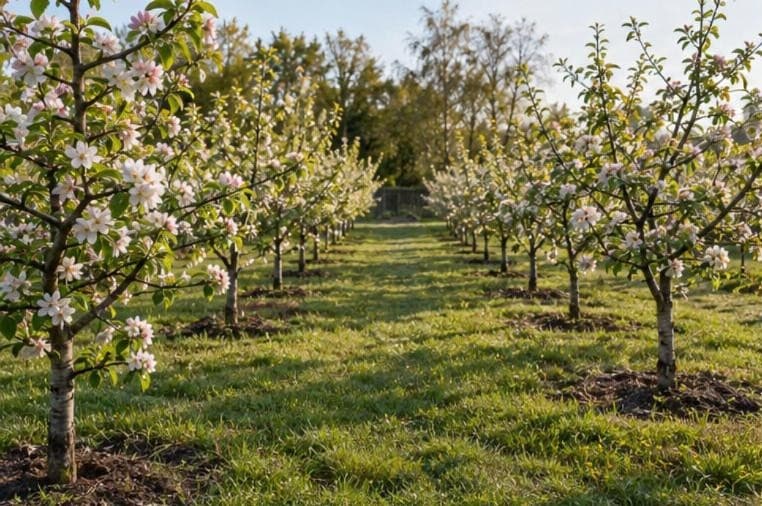
How far apart to plant fruit trees
Space fruit trees by the kind of fruit and its size, from 12 feet for a dwarf pear to 25 feet for a standard pear or a sweet cherry. Virginia Cooperative Extension's home tree fruit guide gives these minimum distances between trees: peach 20 ft, standard pear 25 ft, dwarf pear 12 ft, sweet cherry 25 ft, sour cherry 18 ft and plum 20 ft. NC State Extension's tree fruit chapter allows peaches from 18 ft.
The calculator opens at 19 ft, the middle of that 12 to 25 ft span, laid out the same distance each way. Pick the fruit in the variety menu for its own spacing. For apples, which depend on the rootstock, use the apple tree spacing calculator.
Fruit trees per acre and per row
| Fruit | Spacing used | Trees per acre | Trees in a 100 ft row |
|---|---|---|---|
| Peach | 19 × 19 ft | 120 | 5 |
| Pear, standard | 23 × 23 ft | 82 | 4 |
| Pear, dwarf | 12 × 12 ft | 302 | 8 |
| Sweet cherry | 25 × 25 ft | 69 | 4 |
| Sour cherry | 18 × 18 ft | 134 | 5 |
| Plum | 20 × 20 ft | 108 | 5 |
Each spacing is the value the calculator starts from, the middle of the sources' range. For standard pear that is 23 ft, between NC State's 20 ft and Virginia Tech's 25 ft; use 25 ft if you follow Virginia Tech's minimum. Trees per acre is 43,560 sq ft divided by the ground one tree takes:
trees per acre = 43,560 ÷ (spacing × spacing)
For plums at 20 ft that is 43,560 ÷ 400 = 108. The row counts keep half a spacing clear at both ends; plant on both ends and each row takes one tree more. In the calculator, choose Area and enter your plot in acres or square feet, or Row or windbreak for trees along a fence line.
Years to fruit and yield per tree
Virginia Tech's table shows why the bigger trees get more room: they bear later and give more.
| Fruit | Years to first crop | Yield per tree |
|---|---|---|
| Peach | 3 to 4 | 4 bushels |
| Pear, standard | 5 to 8 | 3 bushels |
| Pear, dwarf | 3 to 4 | 1/2 bushel |
| Sweet cherry | 5 to 7 | 75 quarts |
| Sour cherry | 4 to 5 | 60 quarts |
| Plum | 4 to 5 | 2 bushels |
Plan for pollination
Spacing also has to allow for partner trees. Virginia Tech says pears and sweet cherries need at least two varieties for cross-pollination and plums two of the same type, while sour cherries and peaches are self-fruitful enough to plant alone. A home orchard of pears therefore needs at least two trees, and room for both.
Planting fruit trees
Virginia Tech plants about a month after the first killing frost in fall, or about a month before bloom in spring. Set each tree at the depth it grew in the nursery and never bury the graft union, the joint between fruiting variety and rootstock. Keep it at least 2 inches above the soil: buried, the variety roots on its own and the rootstock no longer controls the tree's size, so a dwarf tree outgrows its spacing.
For any other tree by the acre or hectare, use the tree spacing calculator. Mulch the new trees with the mulch calculator.