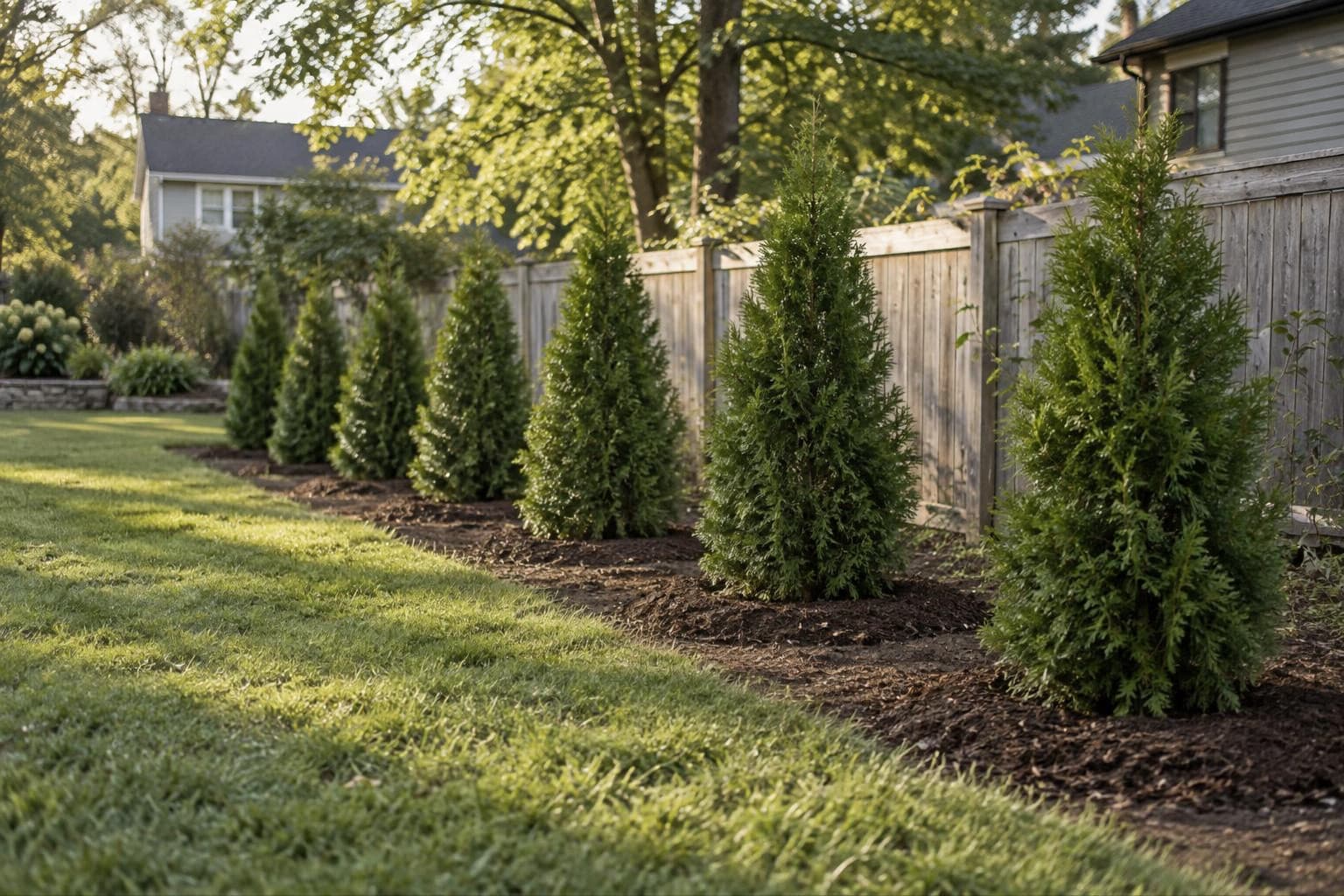
How far apart to plant arborvitae
For a hedge of a narrow arborvitae such as Emerald Green, Oregon State University Extension spaces plants 3 to 4 feet apart, and Washington State University's screens and hedges guide sets hedge plants 4 feet apart in the row. Green Giant is a much bigger tree and needs 6 to 8 feet on center for a dense privacy screen, or about 10 feet if you want each tree to grow to its full shape, as University of Maryland Extension advises.
The calculator starts at 3.5 ft, the middle of the Emerald Green range. Pick Green Giant in the variety menu and it switches to 7 ft. Choose Row or windbreak and enter your hedge length to get the tree count.
How many arborvitae for a privacy screen
| Hedge length | Emerald Green at 3.5 ft | Green Giant at 7 ft |
|---|---|---|
| 10 ft | 2 (3 with trees on both ends) | 1 (2 with trees on both ends) |
| 25 ft | 7 (8) | 3 (4) |
| 50 ft | 14 (15) | 7 (8) |
| 100 ft | 28 (29) | 14 (15) |
The first number keeps half a spacing clear at each end, the way the calculator counts by default, so the hedge stops short of a fence or a neighbor's line. The number in brackets plants the first and last tree right on the ends; for that count, open More options and set the edge to "None, plant on the edge".
A double staggered row (pattern Triangular (staggered), 2 rows), the second row offset by half a spacing, takes about twice the trees: 56 Emerald Green or 27 Green Giant for 100 ft. Maryland Extension notes that staggering also gives each Green Giant more room to spread.
Emerald Green or Green Giant?
The cultivar decides the spacing more than anything else:
- Emerald Green ('Smaragd') matures about 12 to 15 ft tall and only 3 to 4 ft wide. At 3 to 4 ft apart the plants touch at maturity and form a narrow, solid wall that fits along a driveway or a small lot line.
- Green Giant reaches 40 to 60 ft tall and 12 to 18 ft wide, per NC State's plant toolbox. At 6 to 8 ft the trees overlap into one screen; at about 10 ft each tree has room to reach its mature spread.
Green Giant set at Emerald Green spacing would stand 3 to 4 ft apart while each tree spreads 12 ft or more. For a narrow strip, choose a narrow cultivar rather than squeezing a wide one.
Planting arborvitae
Oregon State says to dig each hole twice as wide as the root ball and just deep enough that the top of the ball sits 1 to 2 inches above the ground. University of Maryland Extension prefers spring, from mid to late March; fall planting works if it is done before November, since drying winter winds can brown new plants (winterburn).
Measure spacing from trunk to trunk, the way the sources give it.
More hedge and tree tools
Compare arborvitae with privet, boxwood, yew and other hedge plants in the hedge spacing calculator, or plan a larger planting per acre with the tree spacing calculator. For a screen of a faster, larger conifer, see Leyland cypress spacing. To mulch the new row, the mulch calculator gives the bags or cubic yards.