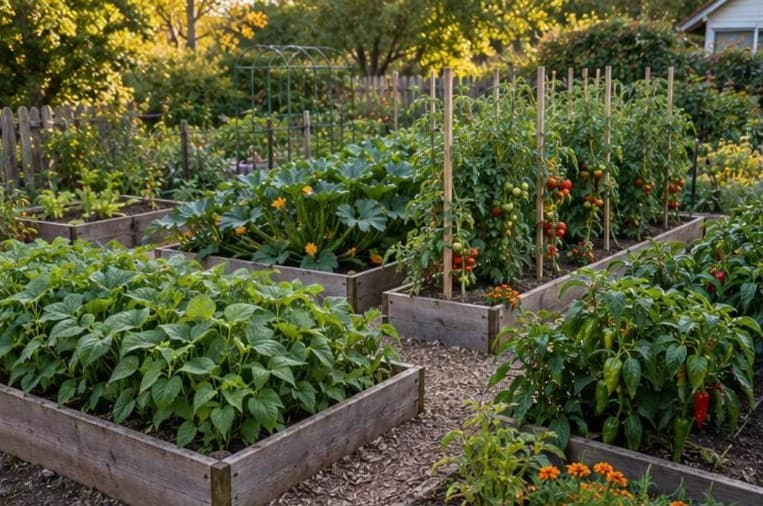
How the calculator sizes a garden
Extension services publish how much of each crop one person needs for a season, either as a number of plants (tomatoes, peppers, strawberries) or as feet of row (beans, carrots, lettuce). The calculator multiplies that figure by the number of people, then turns it into space with the crop's spacing.
Plants = plants per person × people, or row feet × 12 ÷ in-row spacing (in)
Row area (sq ft) = row feet × between-row spacing (in) ÷ 12
Raised bed area (sq ft) = plants ÷ plants per square foot
Row feet come from plants times the middle of the in-row spacing, and the row area uses the middle of the between-row spacing, so a tomato counts at 27 inches in the row with rows 43 inches apart. For raised beds the calculator uses the square foot gardening count where one is published (1 tomato, 4 lettuce or 16 carrots per square foot). Otherwise it uses the published bed spacing, or the in-row spacing in both directions. Beds are counted as 4 by 8 feet, 32 sq ft each, rounded up.
"Fresh + preserving" switches to the larger amount the sources give for canning, freezing or storing. Treat that figure as the whole planting, not an extra on top of the fresh one. "Less", "normal" and "more" pick the low end, the middle and the high end of the published range. Where a source gives only one figure (Utah State lists lettuce for fresh eating only), the crop keeps that figure and says so.
Children count as people. None of the tables we used gives a separate figure for children, so we do not invent one. Enter fewer people if your children eat little of a crop, or set that crop to "less".
Worked example: a family of four
Four people eating fresh, with the default garden of tomato, pepper, cucumber, zucchini, green beans, lettuce, carrot and onion, each at "normal":
| Crop | Per person | For 4 people | In rows | Raised bed | Harvest |
|---|---|---|---|---|---|
| Tomato | 2 to 3 plants | 10 plants, 22.5 ft of row | 81 sq ft | 10 sq ft | 34 to 101 lb |
| Pepper | 3 to 4 plants | 14 plants, 21 ft | 58 sq ft | 14 sq ft | 11 to 38 lb |
| Cucumber | 2 to 3 plants | 10 plants, 12.5 ft | 63 sq ft | 10 sq ft | 10 to 13 lb |
| Zucchini | 1 to 2 plants per planting, 3 plantings | 18 plants (6 per planting), 40.5 ft | 162 sq ft | 36 sq ft | 81 to 324 lb |
| Green beans | 5 to 15 ft | 40 ft | 100 sq ft | 27 sq ft | 12 to 20 lb |
| Lettuce | 5 to 10 ft | 30 ft | 35 sq ft | 11 sq ft | 6 to 12 lb |
| Carrot | 5 to 10 ft | 30 ft | 23 sq ft | 13 sq ft | 21 to 30 lb |
| Onion | 5 ft | 20 ft | 25 sq ft | 9 sq ft | 14 to 20 lb |
That adds up to 545 sq ft in conventional rows, or about 130 sq ft planted intensively, which is 5 raised beds of 4 x 8 ft. The expected harvest is 188 to 558 lb across the eight crops. Switch to fresh + preserving and the same crops need about 312 sq ft of bed, or 10 beds of 4 x 8 ft.
Zucchini is the one crop here counted per planting. Its figure comes from Virginia Tech, whose table gives plants per person per planting and recommends three spring and summer plantings of summer squash, so the season total is 6 plants x 3 plantings. The later plantings can go where early crops such as lettuce have finished, so the area is an upper bound.
In this example rows need about four times the space of beds, because each row carries its own walking path. Raised beds skip those paths and plant in every direction at the in-row spacing or closer.
Plants per person for common crops
These are the figures the calculator starts from. The preserving figure is the total for fresh eating plus canning, freezing or storing.
| Crop | Fresh eating | With preserving | Source |
|---|---|---|---|
| Strawberry | 12.5 plants | 25 plants | NC State, UMaine |
| Asparagus | 5 to 20 plants | none published | UMaine, Illinois Extension |
| Cucumber | 2 to 3 plants | 5 to 8 plants | Utah State |
| Green beans | 5 to 15 ft of row | 15 to 35 ft | Utah State |
| Raspberry | 1.5 to 5 plants | none published | NC State, Illinois Extension |
| Lettuce | 5 to 10 ft of row | none published | Utah State |
| Kale | 5 to 10 ft of row | 20 to 30 ft | Utah State |
| Sweet corn | 10 to 15 ft of row | 40 to 55 ft | Utah State |
| Tomato | 2 to 3 plants | 7 to 13 plants | Utah State |
| Pepper | 3 to 4 plants | 8 to 14 plants | Utah State |
| Zucchini | 1 to 2 plants per planting, 3 plantings | none published | Virginia Tech |
| Potato | 50 ft of row | 100 ft | Utah State |
Why sources disagree
Strawberries show how far apart the tables can be. NC State plans 50 plants for a family of four, 12.5 each. UMaine plans 100 plants for the same family when you also want fruit to freeze or make into preserves. Raspberries range from 6 plants for four people (NC State) to 20 to 25 plants for five (Illinois Extension). Asparagus runs from 5 crowns per person of the newer hybrids (UMaine) to 10 to 20 plants (Illinois Extension).
The calculator lists these other figures under each crop, with links, so you can see where the default sits. Virginia Tech's Table 5 counts plants per person per planting. Where the calculator's figure comes from that table (zucchini, spinach, Swiss chard, leeks, winter squash and pumpkin), it multiplies by Virginia Tech's number of spring and fall plantings: spinach, for example, is 15 plants per person per planting x 4 plantings. Figures from other sources, such as Utah State's, are already season totals and are used as they are. Pair it with the succession planting planner to spread those plantings out.
How reliable the harvest numbers are
Most yields come from Virginia Tech's Table 5 as pounds per 10 ft of row; strawberries use NC State's figure per plant. They are wide ranges. Virginia Tech gives tomatoes 15 to 45 lb per 10 ft and summer squash 20 to 80 lb, depending on variety, season length, water and how well pests are kept down. Read the low end as a first year and the high end as a good year in a well-fed bed. Crops with no published yield, such as asparagus, show no harvest line and are left out of the total.
A few more things move the numbers:
- Variety. Bush and pole beans need very different amounts of row: K-State plans 15 to 16 ft of bush beans or 5 to 6 ft of pole beans per person.
- Climate. Virginia Tech recommends up to three spring and three fall plantings of head lettuce and four spring plantings of bush beans. A short season fits fewer, so each planting needs more row.
- Perennials. A strawberry matted row bears from the year after planting, and asparagus is not cut at all in its planting year. Plan their space apart from the annual beds.
Next steps
Lay the beds out in the raised bed planner, where the same spacing decides what fits in each square. Then use the raised bed soil calculator to fill them: 5 beds of 4 x 8 ft at 12 inches deep hold 160 cubic feet of soil. To check how many plants fit a particular bed or row, the plant spacing calculator draws the layout.